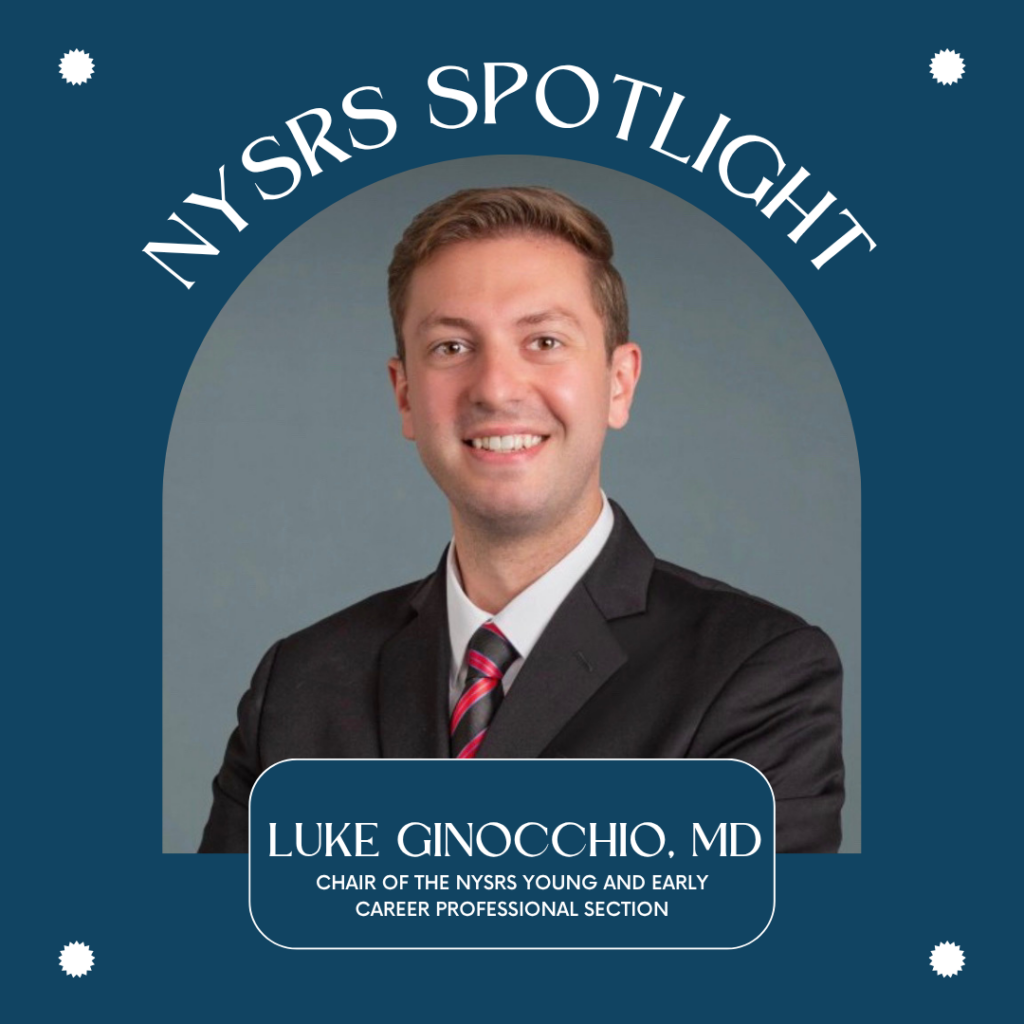
Luke Ginocchio, MD is a Clinical Assistant Professor of Radiology at NYU Langone Health where he specializes in abdominal imaging. He is also the Chair of the NYSRS Young and Early Career Professional Section. His clinical and research interests focus on advanced MRI techniques, including accelerated imaging and artificial intelligence–based reconstruction methods to improve image quality and efficiency. He completed his diagnostic radiology residency and body MRI fellowship at NYU Grossman School of Medicine, and he is actively involved in resident education, research, and professional societies.
1. Why you decided to go into radiology?
I was drawn to radiology because it combines my long-standing interest in science and technology with clinical medicine. Before medical school I studied physics and mathematics, and radiology felt like a natural intersection of those fields with patient care. I enjoy the problem-solving aspect of imaging and the ability to collaborate with physicians across many specialties to guide diagnosis and treatment. Radiology also continues to evolve rapidly with innovations in imaging technology, machine learning, and workflow optimization, which makes it an exciting field to be part of.
2. Favorite moment/experience as part of NYSRS
One of my favorite experiences with the NYSRS has been helping organize and participate in educational programming for trainees and early-career radiologists. Being involved in the society both as a resident and now as a young professional has given me the opportunity to work closely with colleagues across New York, build mentorship relationships, and contribute to initiatives that support the next generation of radiologists. Seeing residents and students connect through these programs and grow professionally has been especially rewarding.
3. Advice for medical students interested in radiology
My biggest advice is to explore the field early and try to experience the breadth of radiology. Spend time on rotations, attend conferences, and talk with radiologists about their day-to-day work. Radiology is much more collaborative and clinically integrated than many people realize. It also helps to develop strong fundamentals in anatomy and clinical reasoning, since imaging interpretation depends on both. Finally, stay curious about technology—fields like AI, advanced MRI techniques, and novel imaging hardware are rapidly shaping the future of radiology.
4. Fun fact about you!
I’ve always had a passion for music. Over the years I’ve attended more than 1,300 concerts—and counting—and at one point I briefly held the Guinness World Record for the “Most Concerts Attended in One Year,” with 229 shows.