New York Priority Legislation
Oppose Limited Scope Radiographer in Urgent Care Settings
Establishment of Limited-Scope Radiographers in the Urgent Care Setting
The New York State Radiological Society is opposed to A2685, Tapia/ S684, Martinez, which would establish limited-scope radiographers in the urgent care setting. This legislation would authorize individuals licensed as limited-scope radiographers to practice radiography at urgent care centers under direct supervision by a licensed practitioner. The Society is primarily concerned that this legislation will compromise patient safety in urgent care settings by allowing individuals who lack sufficient training to position patients and apply radiation to obtain X-ray images.
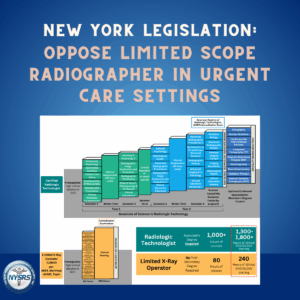
Comparison of radiologic technologist and limited scope radiographer as proposed in A2685/S684:

MEMORANDUM IN OPPOSITION
A2685, Tapia/ S684, Martinez Establishment of Limited-Scope Radiographers in the Urgent Care Setting
The New York State Radiological Society is opposed to A2685, Tapia/ S684, Martinez, which would establish limited-scope radiographers in the urgent care setting. This legislation would authorize individuals licensed as limited-scope radiographers to practice radiography at urgent care centers under direct supervision by a licensed practitioner. The Society is primarily concerned that this legislation will compromise patient safety in urgent care settings by allowing individuals who lack sufficient training to position patients and apply radiation to obtain X-ray images.
Radiologic technologists, commonly referred to as RTs, are medical professionals specially trained to operate diagnostic imaging equipment. This includes using tools like X-rays, magnetic resonance imaging (MRI), and computed tomography (CT) scans. Their primary role is capturing clear and accurate images of the human body, aiding physicians in diagnosing ailments ranging from broken bones to complex diseases. RTs typically receive an associate or bachelor’s degree, which includes detailed curriculum focused on anatomy, physiology, medical terminology, radiation protection, and radiographic procedures. ALARA is an integral part of this curriculum.
ALARA, meaning As Low as Reasonably Achievable, is the guiding principle of radiation safety. ALARA is based on the idea that any amount of radiation exposure, big or small, can increase negative health effects for an individual, including cancer. ALARA dictates that every effort should be made to reduce the patient’s exposure to radiation. Numerous regulatory agencies recognize and require adherence to ALARA as the fundamental standard of radiation safety. The NYSRS is concerned that this legislation is at cross purposes with the guiding principles of ALARA.
RTs receive specialized training that prepares them for the responsibilities of their role and provides them with the knowledge and skill necessary to minimize the radiation dose to the patient. In other states where they are authorized, limited scope radiographers need only a high school diploma or equivalent. Unlike RTs, limited radiographer training programs can be as little as 6 weeks conducted entirely online. This significant discrepancy increases the likelihood of imaging errors that could lead to unnecessary radiation exposure and inferior imaging leading to delayed or inaccurate diagnosis. The safe and effective use of radiologic imaging requires specialized education and hands-on experience to ensure that patients receive the highest standard of care. Introducing lesser trained individuals poses a direct risk to patient health and safety.
Notably, this proposal is being driven by urgent care centers themselves, with no evidence of support from any individuals or entities seeking limited scope radiographer licensure. This highlights the clear financial motives behind this proposal, as urgent care centers aim to cut costs by paying less for this important service, rather than prioritizing patient safety and high-quality imaging standards. Such cost-cutting measures in radiologic imaging go against what is in the best interest of the patient.
U.S. Bureau of Labor Statistics’ latest data from 2023 shows that New York ranks #4 in the nation for having the highest employment level of RTs. Employment data from the American Association of Radiologic Technologists (AART) shows higher employment of RTs in settings that provide market rate compensation and opportunities for career advancement. The average annual salary for a NY-based RT is approximately $85,000. AART data shows that nationally, clinic-based RTs earn 20% less than hospital-based RTs. Sacrificing patient safety to allow hiring of lesser trained and less expensive individuals to protect the financial bottom line of urgent care clinics is unreasonable and irresponsible.
Further, New York State does not have a clearly defined designation for urgent care centers and the definition provided in this proposal is overly broad. This proposal opens the door for unintended utilization of limited scope radiographers, inconsistent standards of care, and significant compromises to New York’s current patient safety standards.
Rather than lowering standards for radiologic imaging, New York should prioritize policies that maintain current training and credentialing requirements to protect patients and ensure high-quality medical imaging. For this reason, we are opposed to A2685, Tapia/ S684, Martinez and urge its defeat.